
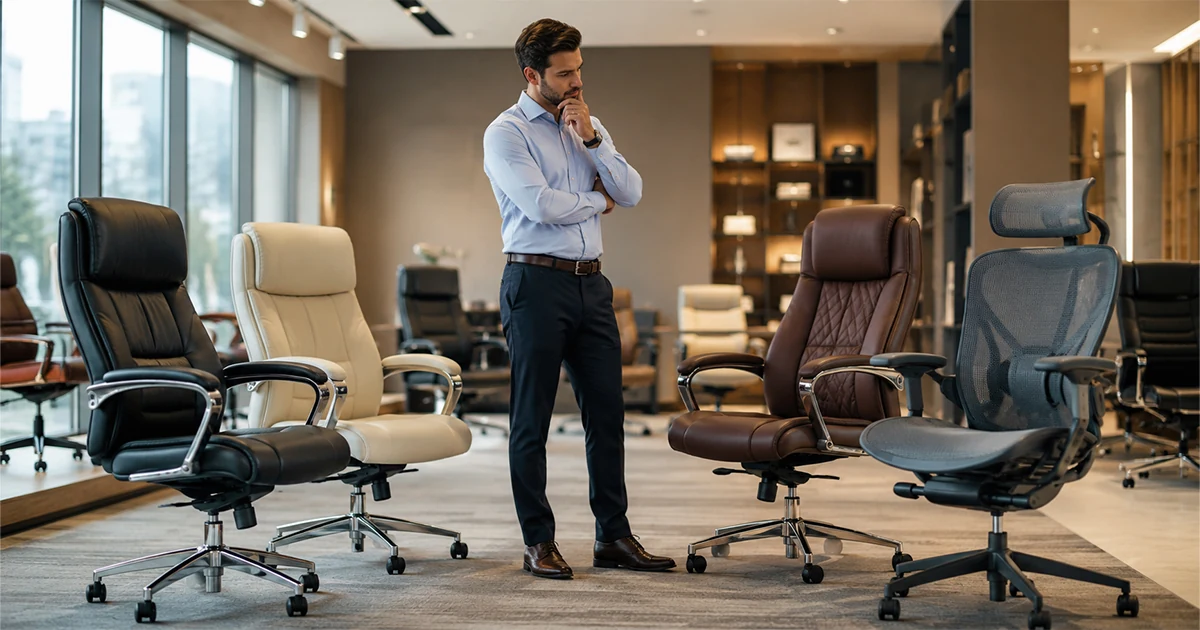
How do I choose the right executive chair?
Executive chairs are about presence, comfort and longevity. Here is what separates a real one from a costume.
An executive chair is two things at once: a seat you spend 8+ hours in, and a silent ambassador for the office or majlis it sits in. Cheap "executive-style" chairs nail the visual cue and fail the rest. Here is how to spot a real one.
1. The frame and base
A real executive chair has a die-cast aluminium or chrome base — never plastic, no matter how heavy it looks. The gas lift should be a Class-4 cylinder rated for at least 130 kg.
2. The leather
Top-grain or full-grain leather ages well; bonded leather peels within 12–18 months in Saudi indoor heat. If the spec sheet just says "leather" without naming the grade, assume bonded.
3. The padding
High-density moulded foam keeps its shape for 5+ years. Stitched cushions that bulge after a month are a sign of low-density foam that will flatten quickly.
4. The mechanism
Look for a multi-lock synchronised tilt with at least three positions plus a free-float mode. Cheap chairs only offer a forward-back rocker.
5. Armrests
4D adjustable armrests (height, width, depth, angle) are standard on real executive chairs above SAR 3,500. Anything below should at least offer 2D height + width.
Style cues that age well
- Neutral black or dark brown leather
- Polished chrome or brushed-aluminium accents
- Stitching that follows the seam — never decorative quilting on the sit pad
Where executives go wrong
The most common mistake is choosing on visuals alone. A heavily padded high-back chair looks imposing but pushes the head forward; over 8 hours that builds neck strain. Always sit in one for at least 10 minutes before buying.
SeatSpace carries executive chairs from Bestuhl and other premium brands — every model is tested for 8-hour comfort, not just showroom presence.


